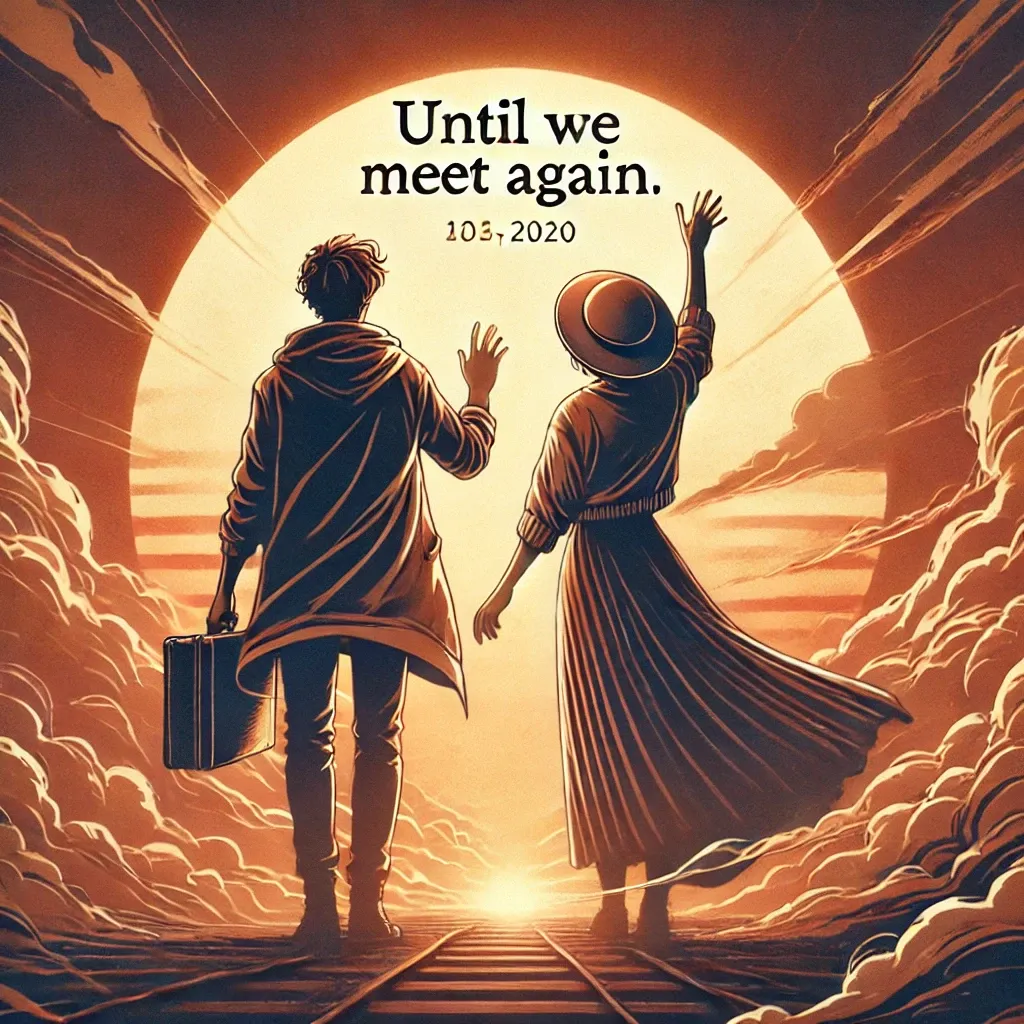
Until we meet again means goodbye for now, said in a way that promises the parting is only temporary. The wording is much older than any song that carries it: Shakespeare put it in the mouths of two characters in the 1590s, and it has been a standard English farewell ever since.
What is the origin of the phrase ‘until we meet again’?
The precise origin of the phrase ‘until we meet again’ remains unclear, although I can say that it appears to have become popularised by the American singer and actor Roy Rogers, with his quote:
“Until we meet again, may the good Lord take a liking to you.”
That is a way of saying goodbye while also wishing the best of luck for the person or people until you all have the opportunity to meet again.
The phrase ‘until we meet again’ can be used in place of the word ‘goodbye’ for many reasons. If you have grown attached to the person or people in question you may wish to remind them or to insist that your time apart will only be temporary, particularly if you are already planning on meeting them again. The phrase also inspires hope that you will see each other again, and it adds variety to conversation, compared to the everyday word ‘goodbye’.
The phrase also appears in Latin, specifically “Ad occursum futurum (nostri)” which translates to “Until a future meeting (of us)”
The exact wording is at least Elizabethan, and Shakespeare uses it twice. In Henry VI Part 3, Edward takes leave of his lords before the battle between Towton and Saxton: “Now, lords, take leave until we meet again, / Where’er it be, in heaven or in earth.” In Richard III, Rivers says it on the way to his execution at Pomfret: “Come, Grey, come, Vaughan, let us here embrace. Farewell, until we meet again in heaven.” The sense in both places is the modern one, a goodbye that holds out a reunion, and in both places the reunion the speaker has in mind may be after death rather than before it.
If Roy Rogers did make it his sign-off, he was reaching for a formula that had been in print for more than three centuries.
Two songs fixed the phrase in many people’s ears, and the first of them was a hymn. Jeremiah Rankin, minister of the First Congregational Church in Washington, D.C., wrote “God Be With You Till We Meet Again” out of the etymology of goodbye, which is short for ‘God be with you’. The Tabernacle Choir dates it to 1882 and gives Rankin’s own account of writing it: it “was deliberately composed as a Christian hymn on basis of the etymology of ‘goodbye,’ which is ‘God be with you.’” He took the idea from a dictionary definition of good-bye, and William Tomer, music director at Grace Methodist Episcopal Church, wrote the tune.
The second was a wartime song. “Till We Meet Again”, with music by Richard A. Whiting and a lyric by Raymond B. Egan, was published in New York and Detroit by Jerome H. Remick and Co., and the sheet music is stamped “Copyright MCMXVIII”, that is 1918. It appeared in the last year of the First World War, and for many people the phrase still sounds like its lyric.
English keeps a large stock of these parting formulas, among them the borrowed ‘hasta la vista’ and the clipped ‘toodle-oo’. Those two close the conversation. This one also makes a promise about the next meeting.
What are some notable uses of the phrase ‘until we meet again’?
In addition to its use in everyday conversation, you will find the phrase ‘until we meet again’ in works of literature, such as in The Grapes of Wrath by John Steinbeck.
The phrase is often used in Disney movies during emotional parting scenes, to emphasise the hope and certainty of future reunions. The phrase also appears in the classic film Casablanca, released in 1942.
‘Until we meet again’ was also a phrase that was frequently used by the former Prime Minister of Great Britain to convey hope and resilience during his many speeches throughout World War II.
The sentiment of the phrase, although not its exact wording, is echoed in the song ‘“We’ll Meet Again” by Vera Lynn released in 1939, and in Robert Burns’ famous song “Auld Lang Syne” dating back to 1788.