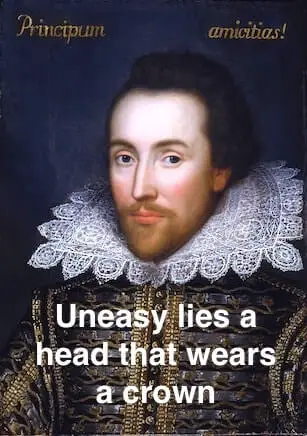
Uneasy lies the head that wears a crown means that those who hold power cannot rest easy. Shakespeare gave the line to King Henry in Henry IV, Part 2, Act 3, scene 1, and wrote ‘a crown’, not ‘the crown’. The two forms people most often quote, ‘uneasy lies the head that wears the crown’ and ‘heavy is the head that wears the crown’, are both rewordings of it.
What’s the origin of the phrase ‘Uneasy lies the head that wears a crown’?
‘Uneasy lies the head that wears a crown’ comes from Shakespeare’s Henry IV. Part II, 1597.
KING HENRY IV:
And in the visitation of the winds,
Who take the ruffian billows by the top,
Curling their monstrous heads and hanging them
With deafening clamour in the slippery clouds,
That, with the hurly, death itself awakes?
Canst thou, O partial sleep, give thy repose
To the wet sea-boy in an hour so rude,
And in the calmest and most stillest night,
With all appliances and means to boot,
Deny it to a king? Then happy low, lie down!
Uneasy lies the head that wears a crown.
In this piece Henry is bemoaning his position as king in that he, unlike even the most humble cabin-boy, cannot find a moments peace and repose.
The speech is Act 3, scene 1, which the Folger Shakespeare edition of Henry IV, Part 2 summarises as the scene where ‘an ill and anxious King Henry IV consults with Warwick’. Henry is alone until Warwick arrives, and the famous line is the second half of a couplet: ‘Deny it to a king? Then, happy low, lie down. Uneasy lies the head that wears a crown.’ The ‘happy low’ are his sleeping subjects, and the crown is what stands between him and their rest.
The earliest printed text of the play is the quarto of 1600, and the line is already there in the shape we know it. The Internet Shakespeare Editions old-spelling transcription of Henry IV, Part 2, Quarto 1, 1600 gives it as ‘Vneasie lies the head that weares a crowne.’ The First Folio of 1623 keeps every word and only adds a comma: ‘Vneasie lyes the Head, that weares a Crowne.’ Both of the early texts read ‘a crowne’.
Two rewordings have grown up around the line, and they are what most people are checking when they look it up. One puts ‘the crown’ where Shakespeare put ‘a crown’. The other replaces the opening as well, giving ‘heavy is the head that wears the crown’. Neither is his. The modern-spelling text of King Henry IV, Part 2 at Project Gutenberg prints ‘Uneasy lies the head that wears a crown’, and ‘heavy is the head that wears the crown’ appears nowhere in the play. Both rewordings carry the same sense, which is why they pass without objection, but if the play is what you are quoting, the words are ‘uneasy’ and ‘a crown’.
The same play gave English another phrase that is still in daily use, ‘eaten out of house and home’, which the Hostess says of Falstaff when he has run up a bill she cannot carry.