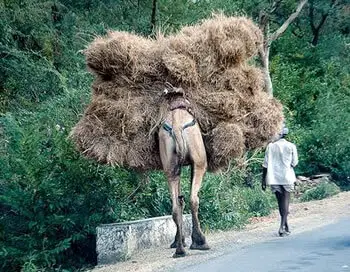
The last straw, also given as the straw that broke the camel’s back, is the small final addition that makes an already heavy burden impossible to bear. The image is older than the camel. It is first found in the 1650s, with a feather and a horse, and the camel form was in print well before Charles Dickens used it in Dombey and Son.
What’s the origin of the phrase ‘The last straw’?
The full version of this metaphorical phrase is ‘the last straw which breaks the camel’s back’, which has an Old Testament sound about it. Searches there produce many references to straw and camels amongst the smiting and begetting, but no ‘last straw’.
The Oxford Dictionary of Quotations lists it as a ‘mid 17th century proverb’, but offers no supporting evidence for that view. The earliest citation that I can find is from The Edinburgh Advertiser, May 1816:
“MR. BROUGHAM remarked, that if it [a tax on soap] were only 3d. a head, or 4d. and 5d. upon the lower orders, yet straw upon straw was laid till the last straw broke the camel’s back.”
The camel was already in print before that. Etymonline’s entry for straw quotes a writer on taxation in The Scots Magazine of April 1799, who reaches for the image and looks east rather than to the Bible for it: “it is, as the Oriental proverb says, the last straw that overloads the camel; a small addition, if ill-timed, may overturn the whole.” That is the 1799 writer’s own framing of the saying rather than evidence of an eastern original.
Some authorities suggest that the phrase is a variant on an olde proverb ‘it is the last feather that breaks the horse’s back’. That may be so. The earliest I can find for that is after 1816 though and, of course, much later than mid 17th century. That’s also from The Edinburgh Advertiser, in November 1829:
“It may be very well for Mr. O’Connell, in his own exultation of heart, to ascribe the success of the Catholic Relief Bill to his ‘agitation;’ but the fact is, that ‘agitation’ was only the cause of Emancipation in the same sense in which it is true that the last feather breaks the horse’s back.”
The feather and the horse go back a great deal further than 1829, and further than the camel. They belong to the argument about liberty and necessity that Thomas Hobbes conducted in print with John Bramhall, Bishop of Derry. Hobbes used the comparison, and Bramhall quoted it back at him: “as the last feather may be said to break a horse’s back, when there were so many laid on before that there wanted but that to do it.” Bramhall’s reply was first published in 1655, which puts the feather and the horse a century and a half ahead of the earliest camel above.
Last but not least there is, or rather was in 1843, a merger of the two phrases. This appeared in The Southport American in October 1843:
“And finally, the ‘feather which breaks the camel’s back’ having been added to Sir Walter’s burthen, he was struck down by paralysis, and after lingering a few months, was gathered to his fathers.”
Etymonline dates the image in English to 1755 and the clipped form, ‘the last straw’ standing on its own without the camel, to 1836. Charles Dickens used the camel version in Dombey and Son, whose preface he dated 24 March 1848: “As the last straw breaks the laden camel’s back, this piece of information crushed the sinking spirits of Mr Dombey.” The Cambridge Dictionary now treats the long and short forms as one idiom and defines it as “the last in a series of unpleasant events that finally makes you feel that you cannot continue to accept a bad situation”.
The straw does the work in the phrase because it weighs almost nothing, and English puts the same straw to a different use in clutch at straws, where a drowning man grabs at something too slight to save him.