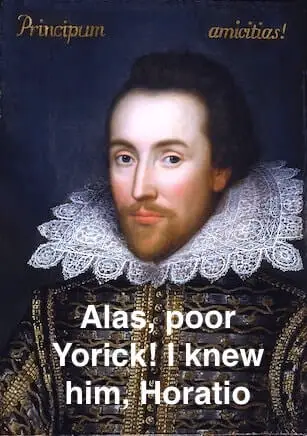
It isn’t “I knew him well”, but “I knew him Horatio”.
Yorick was a court jester he had known as a child, and he grieves for him. In this complex speech, which is one of the best known in all dramatic works, Hamlet goes on to consider the fate of us all when he compares the skull to those still living: “let her paint [her face] an inch thick, to this favour [state] she must come”
As a child Hamlet found the jester Yorick amusing and entertaining. They used to play and frolic in an intimate but innocent way. Now that Yorick is a stinking corpse the memory of touching him seems revolting and makes Hamlet feel ill.
What’s the origin of the phrase ‘Alas, poor Yorick! I knew him, Horatio’?
‘Alas poor Yorick, I knew him Horatio’, which for some reason is often misquoted as ‘Alas poor Yorick, I knew him well’, is from Shakespeare’s Hamlet, 1602.
HAMLET:
Alas, poor Yorick! I knew him, Horatio: a fellow of infinite jest, of most excellent fancy: he hath borne me on his back a thousand times; and now, how abhorred in my imagination it is! my gorge rises at it. Here hung those lips that I have kissed I know not how oft. Where be your gibes now? your gambols? your songs? your flashes of merriment, that were wont to set the table on a roar? Not one now, to mock your own grinning? quite chap-fallen? Now get you to my lady’s chamber, and tell her, let her paint an inch thick, to this favour she must come; make her laugh at that.