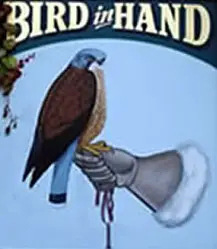
A bird in the hand is worth two in the bush means that what you already hold is worth more than a prize you might never get. It is an English proverb from 1450, in its modern wording by 1670. The Cambridge Dictionary glosses it as advice that “you should not risk losing something you already have by trying to get something you think might be better”. John Capgrave has the earliest known English form; John Ray’s collection of 1670 gives the shape still in use.
Where did the saying ‘A bird in the hand is worth two in the bush’ come from?
‘A bird in the hand is worth two in the bush’ is one of the oldest and best-known proverbs in English. It came into the language in the 15th century, probably imported from other cultures. The proverb warns against taking unnecessary risks. It is better to keep what you have (a bird) than to risk getting more and ending with nothing (two birds which are out of your reach).
Origin - the full story
This proverb, like many others, warns against taking risks. It suggests that you should keep what you have and not risk losing it by going after more. The allusion may be to falconry where a bird in the hand (the falcon) was a valuable asset and certainly worth more than two in the bush (the prey).
This proverbial saying is first found in English in John Capgrave’s The Life of St Katharine of Alexandria, 1450:
It is more sekyr [certain] a byrd in your fest, Than to haue three in the sky a‐boue.
The Early English Text Society printed Capgrave’s poem in 1893 from two manuscripts. Its text has the line as “It is more sekyr a byrd in your fest”, and its glossary gives fest as fist. The same speech does not stop at the bird. Capgrave’s speaker goes straight on to a second saying, “The grey hors, whil his gres groweth, May sterue for hunger”. He is quoting sayings his hearers already knew, not coining them.
John Heywood’s 1546 glossary A Dialogue conteinyng the nomber in effect of all the Prouerbes in the Englishe tongue also includes a variant of the proverb:
Better one byrde in hande than ten in the wood.
Interestingly, the next line in Heywood’s book (which is form in rhyming couplets) is another of the best known proverbs - “Rome was not bylt on a daie (quoth he) & yet stood”. It’s probable that Capgrave didn’t coin the expression himself - many other languages have variants of it. By how long the phrase pre-dates his publication isn’t clear. The 7th century Aramaic Story of Ahikar has text that modern translations render as
“Better is a sparrow held tight in the hand than a thousand birds flying about in the air.”
Plutarch’s Moralia has text that modern translations give as
“He is a fool who leaves things close at hand to follow what is out of reach.”
Or, as the Czechs have it, ‘a sparrow in the fist is better than a pigeon on the roof’. While very similar proverbs existed in various cultures from antiquity there is no record of it existing in English in the form we now use before the 15th century. Heywood’s book is later than Capgrave’s but it was by far the better known, due to Heywood’s prominent position in the Tudor court. It is Heywood who can be credited as the person who introduced the proverb to the English-speaking world. Variations of the proverb which don’t mention birds existed in English prior to 1530, for example, this piece from Wycliffe’s Bible, 1382:
Ecclesiastes IX - A living dog is better than a dead lion.
Julian Sharman’s 1874 edition of Heywood’s Proverbs adds two things. First, Heywood had used the line about sixteen years before the 1546 book, in his Dialogue of Wit and Folly of around 1530, and he introduces it there as something already worn in: “An old proverbe makyth with thys whyche I tak good. Better one byrd in hand then ten in the wood.” So even Heywood treated it as inherited. Second, Sharman’s text shows the line that runs immediately before the bird line in 1546: “For while the grasse groweth the horse starveth.” That is the same second proverb Capgrave had reached for in 1450, which means the pair had been travelling together for the best part of a century.
The number of birds was not fixed, and neither was where they were hiding. Capgrave counted three in the sky and Heywood ten in the wood. Hugh Rhodes’s The Boke of Nurture, or Schoole of Good Maners, reprinted by Frederick J. Furnivall in The Babees Book, 1868, from the edition of 1577, tells a waiting servant that “A byrd in hand, as some men say, is worth ten flye at large”. The two in the bush we use today is recorded in John Ray’s A Collection of English Proverbs, 1670, which lists it as “One bird i’th’ hand is worth two in the bush”, and the entry stands unchanged in Ray’s enlarged second edition of 1678. In Ray the number has settled at two and the bush has replaced the wood.
The expression fits well into the catalogue of English proverbs, which are often warnings, especially warnings about hubris or risk-taking. Some of the better known examples that warn against getting carried away by some exciting new prospect are these:
All that glitters is not gold. Fools rush in where angels fear to tread. Look before you leap. Marry in haste, repent at leisure. The best-laid schemes of mice and men gang aft agley.
The Bird in Hand is a common English pub name. The Bird in Hand was adopted as a pub name in England in the Middle Ages and many with this name still survive. English migrants to America took the expression with them and ‘bird in hand’ must have been known there by 1734 as this was the year in which a small town in Pennsylvania was founded with that name. Other modern day European languages and cultures have their own version of this proverb:
In Czech - ‘Lepsi vrabec v hrsti nez holub na strese’. (A sparrow in the fist is better than a pigeon on the roof.) In German - ‘Der Spatz in der Hand ist besser als die Taube auf dem Dach’. (The sparrow in the hand is better than the dove on the roof.)
The close similarity of these suggests that one is a translation of the other. Which came first and whether either pre-dated the English version we can’t now be sure.