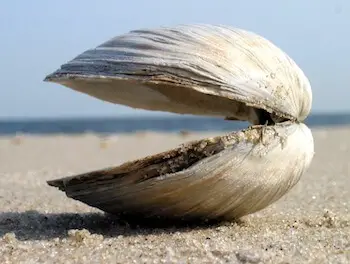
As happy as a clam means completely contented, with nothing to worry about. The saying is American and was in print by 1833. Its full form is ‘as happy as a clam at high water’, normally taken to mean that a clam is at its safest when the tide covers it and it cannot be dug up.
What’s the origin of the phrase ‘As happy as a clam’?
Why would clams be happy? It has been suggested that open clams give the appearance of smiling. The derivation is more likely to come from the fuller version of the phrase, now rarely heard - ‘as happy as a clam at high water’. High tide is when clams are free from the attentions of predators; surely the happiest of times in the bivalve mollusc world. The phrase originated in the north-eastern states of the USA in the early 19th century. The earliest citation that I can find is from a frontier memoir The Harpe’s Head - A Legend of Kentucky, 1833:
“It never occurred to him to be discontented… He was as happy as a clam.”
The man described there is a planter too settled in his habits to think of complaining, and the sentence runs in full: “it never occurred to him to be discontented, while she seemed to be satisfied. He was as happy as a clam.” The Online Etymology Dictionary dates the phrase to the same year and glosses it as “be content and pleased”. It also enters a caution of its own. The high water reading is, in its words, what the phrase is “usually said to be in reference to”; but it adds that “the earliest uses do not elaborate, and perhaps the notion is self-containment”.
The first definitive record that I can find of the ‘high water’ version is from the US newspaper The Bangor Daily Whig And Courier, December 1841:
“Your correspondent has given an interesting, and, undoubtedly correct explanation of the expression: ‘As happy as a clam at high water.’”
However, several biographies of General Robert E. Lee state that he used the expression ‘as happy as a clam at high water’ on more than one occasion. One such states that he included it in a letter that he wrote in 1833, which would pre-date the above by a few years. I can’t find a record of the letter in question so the account is second-hand, but it is entirely plausible that Lee would have used the expression at that time.
An earlier printed record of the long form has since been traced. The Grammarphobia Blog reports that “The ‘high water’ version first showed up in ‘The Oakwood Letters,’ a humor series published in several different newspapers in 1836”. That puts the fuller wording within three years of the first record of the short one, and five years ahead of the Bangor citation above.
The expression was well-enough known in the USA by the late 1840s for it to have been included in John Russell Bartlett’s Dictionary Of Americanisms - A Glossary of Words And Phrases Usually Regarded As Peculiar To The United States, 1848:
“As happy as a clam at high water,” is a very common expression in those parts of the coast of New England where clams are found.
Also in 1848, the Southern Literary Messenger from Richmond, Virginia expressed the opinion that the phrase “is familiar to everyone”.
Which half came first is not settled by the dates alone, and Bartlett’s own later edition, published in Boston in 1860, treats the short one as the ordinary form: ‘happy as a clam’ is there called “a common simile in New England, sometimes enlarged to ‘happy as a clam at high-water’”.
The tide is not the only reason the 19th century gave for the clam’s good mood. The Knickerbocker for March 1838 called ‘Happy as a clam’ an old adage and put the creature’s ease down to its armour rather than the water, describing it as “Ensconced in his mail of proof”. By the middle of the century the simile was worn enough to be argued with. John Godfrey Saxe’s ‘Sonnet to a Clam’, printed in his Poems of 1851, takes the clam’s side against it: “Albeit men mock thee with their similes / And prate of being ‘happy as a clam!’”
See other ‘as x as y similes’.
See other phrases that were coined in the USA.