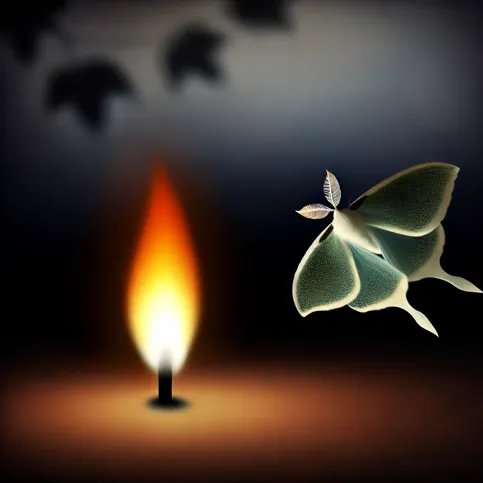
Like a moth to a flame means irresistibly drawn towards a person or a thing that is likely to harm you. The picture is Elizabethan and the wording is Victorian. Shakespeare had Portia speak of a candle singeing a moth in 1596, but the phrase ‘the moth to the flame’ has not been found in print before the middle of the 19th century; the earliest dated example traced here is from 1859.
What’s the origin of the phrase ‘Like a moth to a flame’?
The phrase is a simple allusion to the well-known attraction that moths have to bright lights. The word moth was used in the 17th century to mean someone who was apt to be tempted by something that would lead to their downfall. This is referred to by Shakespeare in The Merchant of Venice, 1596:
“Thus hath the candle singd the moath.”
The Shakespeare line is Portia’s, and it falls at the end of Act 2, Scene 9, just after the Prince of Arragon has chosen the silver casket and lost his suit. The Folger Shakespeare text prints it in modern spelling as “Thus hath the candle singed the moth.” Two scenes earlier the same run of caskets produced another phrase still in daily use, all that glitters is not gold.
The word itself had shifted not long before Shakespeare used it. The Online Etymology Dictionary’s entry for moth records that “Until 16c. the word was used mostly of the larva and usually in reference to devouring woolen fabrics”, which is to say the grub in the wardrobe rather than the insect at the window. The winged moth that beats itself against a light was a comparatively new thing for the word to mean when Portia named it.
Getting from Shakespeare’s candle to the modern flame took a long time. An anonymous song printed in The Beauties of Glasgow, by J. and M. Robertson in 1802, puts the picture to work on a young woman heading for ruin:
“How, like a moth, the simple maid
Still plays about the flame!”
The wording “the moth to the flame” turns up a generation after that. Roland Folger Coffin’s Straws, printed at Cambridge, Massachusetts in 1859, carries a line in a piece headed “A Fragment” that reads “As the moth to the flame that burns.” Samuel Lover used the same wording the following year, in Metrical Tales and Other Poems, published in London in 1860, of a fugitive running straight at the thing that will destroy him, in a line ending “Fate beckons her victim to death and to shame!”
So the question of when the saying came about has two answers. The image of a moth destroying itself in a candle flame, and of a person doing much the same, was current in English by the 1590s. The set wording with “flame” in it has not been traced before the 1850s, and it is that later wording rather than Shakespeare’s candle that gives us the simile in use today.
As a warning it sits close to fools rush in where angels fear to tread and curiosity killed the cat, though both of those describe recklessness where this one describes attraction.