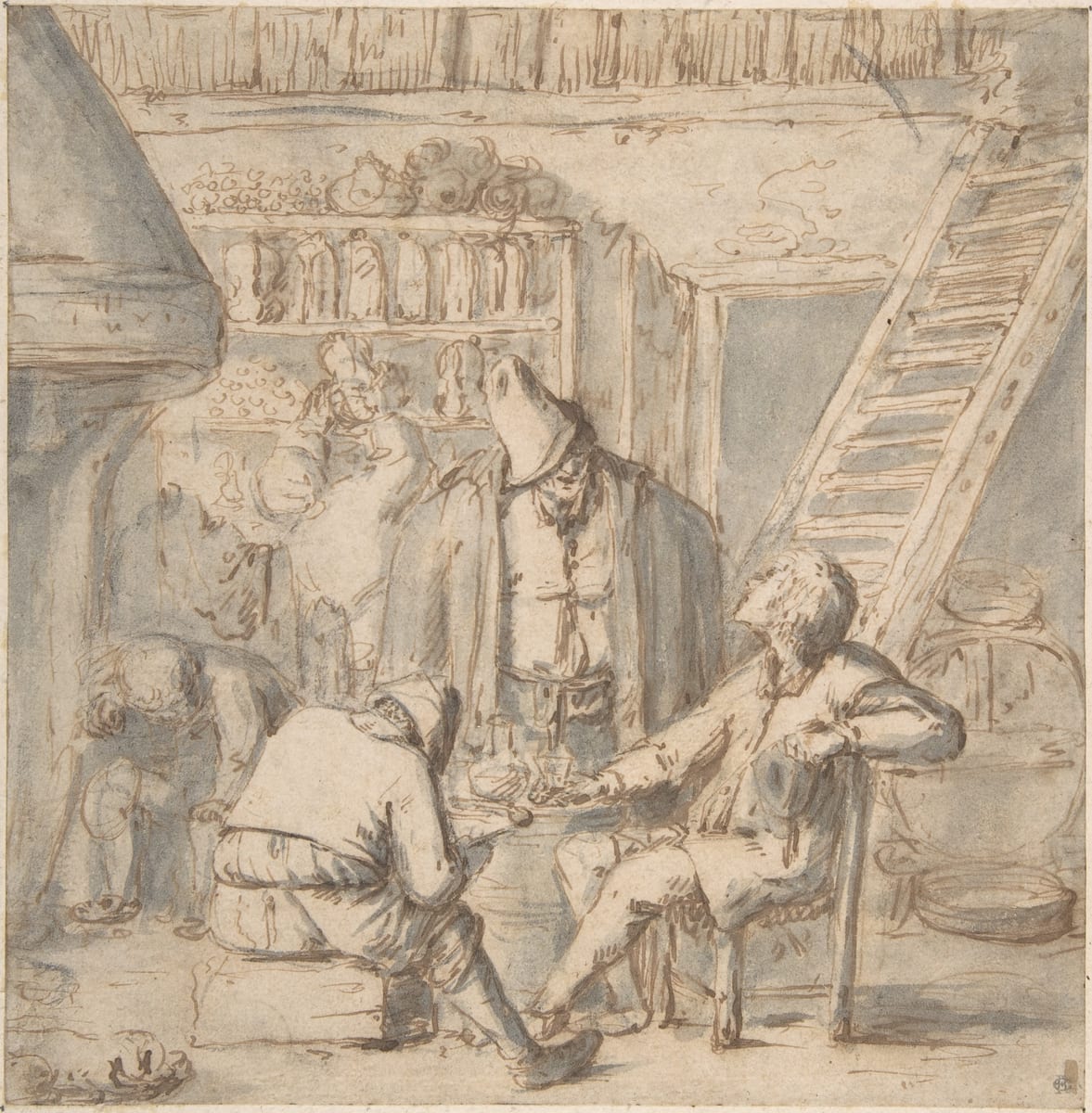
To be in your cups is to be drunk. The phrase is an old and now distinctly genteel euphemism: an obituary or a court report will say that a man was ‘in his cups’ where his friends would simply have said he was drunk. Its earliest uses could carry a milder sense, the middle of a drinking bout rather than the worse for it, but the drunken sense won out long ago. The pronoun bends to fit: in his cups, in her cups, in their cups.
What’s the origin of the phrase ‘in his cups’?
The image is a straightforward one. Before drinking settled into bottles and stemmed glasses, wine and ale were taken from cups, and a session was a matter of the cups going round the table. To be ‘in’ your cups was to be deep in that process, with intoxication following close behind.
The idea is older than the English wording. The Romans had ‘inter pocula’, literally ‘amid the cups’, for what people say and do over drink; Virgil uses it in the Georgics, where country folk make merry ‘inter pocula laeti’ at festivals of Bacchus. Medieval English had its own cup-based formula too: ‘cup-shoten’, meaning drunk, is recorded from the mid fourteenth century.
The ‘in his cups’ pattern itself settles into print around 1600. Shakespeare has a version of it in Henry V, written around 1599, when Fluellen makes his laboured comparison between the king and Alexander the Great: ‘as Alexander killed his friend Cleitus, being in his ales and his cups; so also Harry Monmouth, being in his right wits and his good judgments, turned away the fat knight’. Being in your cups there is plainly being drunk, and dangerously so, since Alexander killed his friend in that state.
The wording most often quoted as the source appears in the King James Bible of 1611, in the Apocrypha. The First Book of Esdras stages a debate on what is strongest, wine, the king, women or truth, and the case for wine includes this (1 Esdras 3:22): ‘And when they are in their cups, they forget their love both to friends and brethren, and a little after draw out swords.’ The King James translators did not coin the phrase, as the Henry V line shows, but the Bible’s vast circulation did more than anything else to fix it in the language.
The expression has barely changed jobs since. It survives precisely because it is not blunt: saying that someone was in his cups lets a speaker record the drunkenness while sounding too polite to name it. Everyday English has livelier options, from ‘three sheets to the wind’ downwards, but this one keeps its place as the tactful choice.