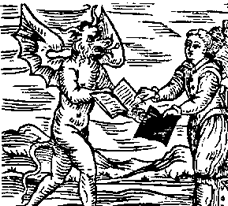
‘The devil is in the details’ means that a plan which looks simple and agreeable in outline hides its real difficulties in the small particulars, and that those particulars are where it will go wrong. It is an inversion of an older German saying, ‘Der liebe Gott steckt im Detail’, God is in the detail, whose earliest dated record is the notice of a Hamburg seminar given in November 1925. The English devil form is much younger and belongs to the second half of the twentieth century.
What’s the origin of the phrase ‘The devil is in the details’?
The source of the proverb ‘The devil is in the details’ is often attributed to the German/American architect Ludwig Mies Van Der Rohe. This is almost certainly a misattribution. The expression derives from an earlier German proverb - “Der liebe Gott steckt im detail”, which translates as ‘God is in the detail’. Mies Van Der Rohe is also associated with this earlier form but, although he may have used it, there’s no evidence that he was the first to do so.
A date can now be put on that earlier German form, and it is a documentary one rather than a literary one. The Yale Book of Quotations, quoted by its editor Fred Shapiro at Freakonomics in January 2010, traces ‘Der liebe Gott steckt im Detail’ to the notice of a seminar that the art historian Aby Warburg gave at Hamburg University on 11 November 1925, from papers held at the Warburg Institute in London. That is the earliest date the Yale Book of Quotations gives the saying, more than forty years before Mies Van Der Rohe died.
In the migration of the phrases an ‘s’ was added - the earlier form is usually ‘God is in the detail’; the later form is more commonly ‘the devil is in the details’.
The swap of God for the devil happened in German too, and earlier than in English. Redensarten-Index, the German dictionary of idioms, records ‘Der Teufel steckt im Detail’ as a proverb in its own right and, citing the slang lexicographer Heinz Küpper, dates it to about 1940.
‘The devil is in the details’ only came into common use in the 1990s (Van Der Rohe died in 1969) and the earliest citation of it that I’ve found in print is in Richard Mayne’s explanation of the workings of the European Union - The Community of Europe, 1963:
On the principle that ‘the devil is in the details’, what should have been a merely formal occasion developed into a debate about the Community’s official languages and the site of its headquarters.
The Yale Book of Quotations gives a slightly later first attestation for the English proverb: The Times of London, 9 July 1969. That is six years after Mayne, but it still puts the devil form in a national newspaper in the year Mies Van Der Rohe died, two decades before the phrase became common.
The phrase might have been tailor-made for negotiations between European Union countries, which are known for their labyrinthine and hair-splitting attention to detail.
The word doing the work in both versions carries the meaning already. Etymonline dates ‘detail’ in English to about 1600 and takes it from an Old French word for a “small piece or quantity,” literally “a cutting in pieces,” with the sense of “an individual part, a particular” arriving by 1786. On that etymology a detail is a piece cut from a whole, and the proverb bites on plans agreed in outline and then broken into clauses. The same ground is covered by the nitty-gritty and by the warning that a chain is only as strong as its weakest link.