To put on a front is to fake an outward manner, usually confidence or calm, that you do not actually feel. Someone putting on a front smiles through money troubles, acts breezy after bad news, or plays the thriving professional while quietly sinking. “Put up a front” means exactly the same, and both shade into “keeping up a front” once the performance has to be sustained. The phrase is informal but universal, said of stoics and fakers alike, and the noun does the real work: the front is the false surface, with the true state of affairs somewhere behind it.
What’s the origin of the phrase ‘put on a front’?
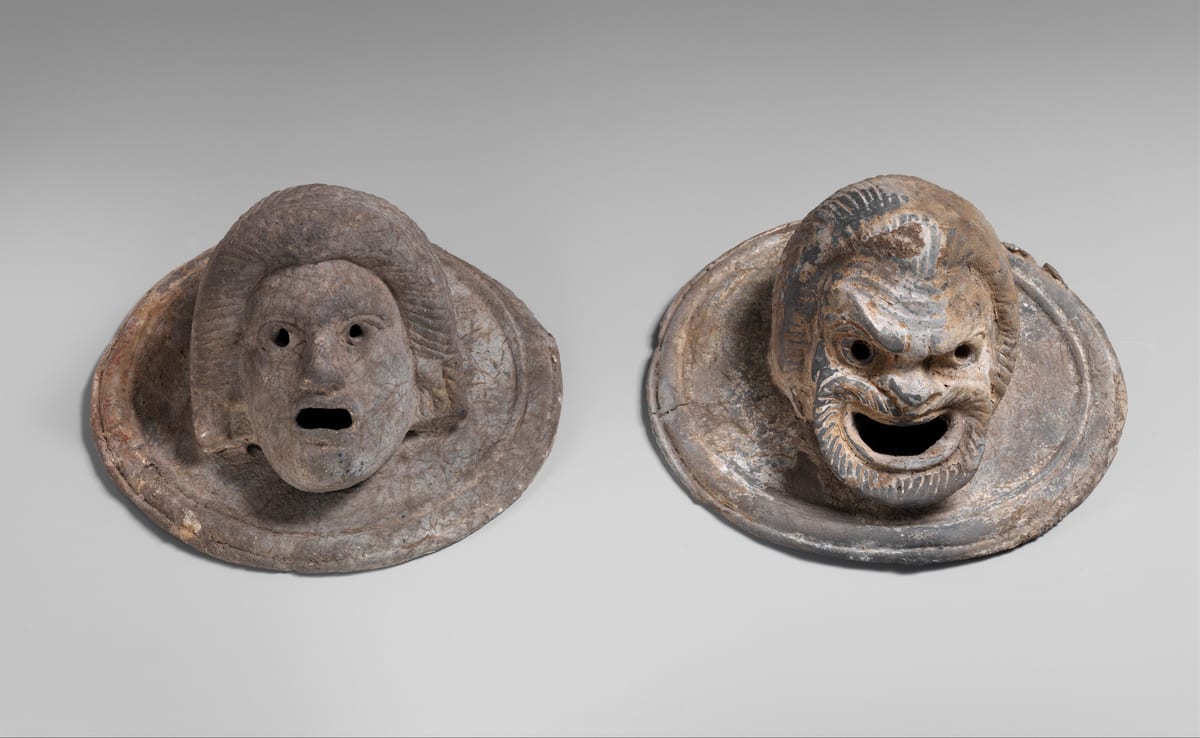
“Front” came into English from Old French front, meaning forehead or brow, from the Latin frons. The etymologist’s story is all there in the Latin word, which according to Etymonline covered the forehead and brow, the facade of a building, and external appearance generally. For centuries English kept the literal sense of the face. Shakespeare opens Richard III, written in the early 1590s, with “Grim-visaged war hath smooth’d his wrinkled front”: war’s brow, no longer frowning. The Romans also held that shame showed on the brow, which is why a Late Latin word for “barefaced” gave English “effrontery”, shamelessness, in the early eighteenth century.
The step from face to performance came through the idea of bearing. To “show a bold front” was to face trouble with a composed and confident look, an image drawn partly from the face and partly from the battle line an army presents to the enemy. By the mid-nineteenth century it was ordinary idiom for confidence assumed rather than felt. In Anthony Trollope’s The Warden (1855), Mr Harding, resigning his comfortable post and facing sudden poverty, tells his daughter:
We must put a bold front on it, Nelly; it isn’t easy to come down from affluence to poverty.
That is already the modern meaning in full: dignity performed for the world while the reality is otherwise.
The bare noun, a “front” as the false show itself, is late-Victorian slang. Etymonline dates the “public facade” sense to 1891, and Green’s Dictionary of Slang has a citation from that same year, an account of tramping through America: “All you have to do is put a good ‘front on,’ and waltz in with the crowd.” In the criminal underworld the front became professional equipment. Green’s quotes a 1916 underworld memoir observing that “a good ‘front’ (appearance) in their line is essential to success”, and by then the word was also being used for a respectable cover masking illegal business, a sense Etymonline dates to 1905. Jack Black’s 1926 memoir You Can’t Win, cited by Green’s, describes a store that “was but a ‘front’ or blind for a poker game”. From this use come the front man and the front organisation. Both “put on a front” and “put up a front” were current by the early twentieth century, with the “put up” form especially common in American use.
The newest branch is the verb. Green’s Dictionary of Slang records “fronting”, meaning putting on airs, in a 1971 glossary of Black American English, and by the late 1980s “frontin’” was hip-hop’s standard word for posing, for pretending to toughness, wealth or indifference one does not have. The standing reproach “don’t front” means, simply, stop pretending. The stoic’s version of the same performance is to keep a stiff upper lip.