Preposterous means absurd or ridiculous. The word came into English from the Latin praeposterus, literally ‘before-behind’, so its older and stricter sense was of something with its parts in the wrong order, the cart set before the horse. That literal sense has since dropped out of English and only the sense of ‘absurd’ is left.
What’s the origin of the word ‘Preposterous’?
I know that this site generally deals with phrases rather than single words, but this word packs in enough to be counted as virtually a phrase. We may go through life using ‘preposterous’ as a synonym for ‘absurd; laughable; ridiculous’ without giving any thought to why it means that.
By breaking preposterous into its constituent parts it becomes clear that its meaning can be read quite literally, that is, it describes something in which the ‘pre’ (front) has become the ‘post’ (rear). So, ‘preposterous’ things or, more usually animals, were those which were contrary to nature; having their parts in the wrong order.
Those parts are Latin rather than English. Etymonline takes the word from the Latin praeposterus, which it glosses as ‘absurd, contrary to nature, inverted, perverted, in reverse order’ and, literally, as ‘before-behind’: prae, meaning ‘before’, joined to posterus, ‘coming after’. That is the same picture as ‘put the cart before the horse’ and ‘topsy-turvy’.
A medieval belief in the existence of fabulous animals was commonplace, indeed almost universal. These were drawn and described in books called bestiaries. Many of these medieval books survive and contain numerous examples of the weird and wonderful.
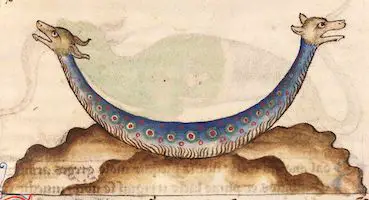
To the usual collection of dragons, griffins, mermaids, unicorns and the like we can also add animals that had heads at both ends, for example the snake-like animal the Amphisbaena. Numerous representations of amphisbaenas exist - all of them different, as befits an invented creature.
The amphisbaena did not begin with the bestiaries. Pliny the Elder had already placed it among the serpents in the Natural History, Book 8, where, in Bostock and Riley’s translation of 1855, ‘it has a second one at the tail, as though one mouth were too little for the discharge of all its venom’. A creature with a head where its tail ought to be is preposterous in the strict sense of the word: its front is at its rear.
The use of ‘preposterous’ to refer to things which were wrong or inverted dates from 1533, when it was so used several times in a translation of Erasmus’ Enchiridion Militis Christiani. That book was printed in London by Wynkyn de Worde for John Byddell on 15 November 1533, and in one passage the translation stops to gloss the word with the proverb itself: ‘is not thy religion preposterous and out of order and according to the common proverb, the cart set before the horse?’
Etymonline dates the English word a little later, to the 1540s, in the sense ‘contrary to nature, reason, or common sense’, and puts the strictly literal sense, ‘reversed in order or arrangement, having that last which ought to be first’, at the 1550s. It marks that literal sense as obsolete now, and describes the meaning of the word as having gradually shaded into ‘foolish, ridiculous, stupid, absurd’. The seventeenth century had a verb to go with the adjective, preposterate, meaning to pervert or invert.
The use of the term to refer specifically to ‘wrong’ animals was in use by at least 1661, when it appeared in Joseph Glanvill’s The Vanity of Dogmatizing:
“Thus our Eyes, like the preposterous Animal’s, are behind us.”
The Cambridge Dictionary, which records only the loose sense, gives ‘very silly or stupid’ and nothing more, with the example ‘The very idea is preposterous!’