Common sense means sound practical judgement, the plain good sense most people are expected to have. The term is older than that meaning: it entered English in the late 14th century as the name of an inner faculty uniting the five senses, and took its modern sense in the 18th century. The Cambridge Dictionary defines it as the basic level of practical knowledge and judgement we all need in order to live in a reasonable and safe way.
What’s the origin of the phrase ‘Common sense’?
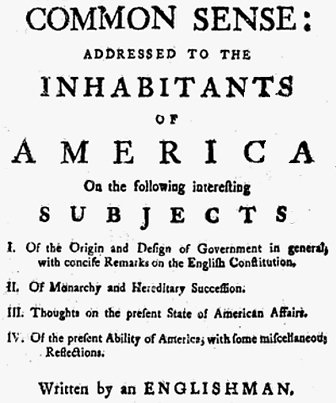
Thomas Paine published a pamphlet entitled Common Sense in January 1776. It called for America to become independent of Britain and a copy of the original is considered a treasure of the US Library of Congress, being one of the wellsprings of the thinking that founded the country. Common sense, that is, a plain practical ‘get on with the job’ philosophy is part of the American psyche.
Paine is sometimes thought to be American but in fact emigrated to the USA after living the majority of his life in the archetypically English country town of Thetford, Norfolk. Despite his radical views he considered himself English and the pamphlet’s author was simply identified as “An Englishman”. Nor, as is also sometimes believed, did he invent the term ‘common sense’, which had been in use in his native land long before Paine’s day.
Paine used the phrase inside the pamphlet as well as on its title page. He opens his section on American affairs by promising the reader ‘nothing more than simple facts, plain arguments, and common sense’. The enlarged Philadelphia edition of the text carries the imprint ‘Printed and sold by W. & T. Bradford, February 14, 1776’.
In the original 14th century meaning of the term, ‘common sense’ was a sense like our other senses. It was an internal feeling that was regarded as the common bond that united all the other human senses, the ‘five wits’ as they were known, and was something akin to what we now call ‘heart’.
By the 16th century, the meaning had changed to be more like our present day meaning, that is, ‘the plain wisdom that everyone possesses’. George Joye used the expression in Apology for William Tindale, 1535:
I am suer T[indale] is not so farre besydis his comon sencis as to saye the dead bodye hereth Cristis voyce.
[Note: ‘apology’ then meant ‘defence against attack’/‘justification of one’s views’, and was commonly used in the titles of scholarly disputes.]
Etymonline sets out the same two stages and gives the term a classical pedigree. It dates the internal-sense meaning to the late 14th century and traces it to the Latin sensus communis and the Greek koine aisthesis, the mental power supposed to unite the impressions conveyed by the five physical senses. It then records the meaning ‘ordinary understanding, without which one is foolish or insane’ from the 1530s, which is the sense Joye is using, and dates the meaning ‘good sense’ to 1726.
The one thing that is usually said about common sense is that it isn’t as common as it ought to be. This little gag was made as early as 1726, by the political writer Nicholas Amhurst in the satirical text The Secret History of the University of Oxford:
There is not (said a shrewd wag) a more uncommon thing in the world than common sense.
By the time that Paine began writing in the 1770s, the term ‘common sense’ had migrated a little more and was widely used to mean ‘primary truth’, that is, the unquestionable beliefs that all people receive from their experience of being alive. Richard Price defined the term in Review of the Principal Questions in Morals, 1758:
Common sense, the faculty of self-evident truths.
By the 1760s the term was also the name of a philosophical position. Thomas Reid, professor of moral philosophy in the University of Glasgow, called his book An Inquiry into the Human Mind, on the Principles of Common Sense; it had reached a corrected third edition, printed in London for T. Cadell, by 1769. Reid put common sense above philosophy rather than under it: “Common Sense holds nothing of Philosophy, nor needs her aid.”
Paine’s work influenced many political and moral thinkers at the beginning of the American Revolution and he was personally acquainted with most of them; in England, these included the feminist Mary Wollstonecraft and the artist William Blake and in America, Benjamin Franklin, George Washington and Thomas Jefferson.
When the authors of the US Declaration of Independence began with the words “We hold these truths to be self-evident…”, their meaning was ‘we believe this declaration to be common sense’.