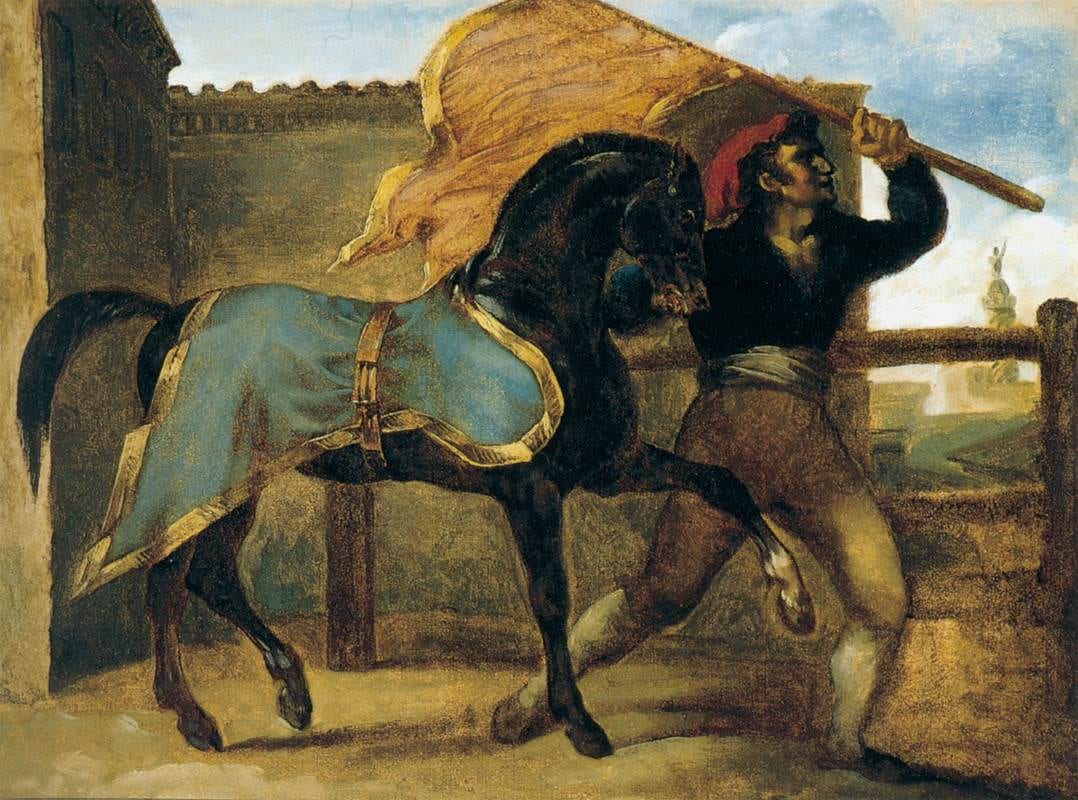
To give someone a run for their money is to push them all the way: a challenger who gives the champion a run for their money loses, if they lose at all, only after a real fight. The other construction, to get or have a run for your money, means to get genuine value, or at least a genuine contest, in return for whatever you have staked or spent. Both versions are informal, both are used throughout the English-speaking world, and both quietly preserve the phrase’s original picture of money riding on the outcome, even when nothing is being bet at all.
What’s the origin of the phrase ‘a run for your money’?
The phrase comes from Victorian horse racing, and specifically from the backer’s side of the rails. The Oxford English Dictionary dates the literal turf use to the late 1830s, defining it as having a successful race from a horse one has backed, especially when that horse had looked likely to be scratched, that is, struck out of the race before the start. Depending on the terms of the bet, a scratched horse could mean a stake settled without a race ever being run. A horse that actually started gave its backer the minimum he was entitled to hope for: a run for his money.
Green’s Dictionary of Slang traces the expression in print to the sporting press, quoting the Sporting Review in 1856 on “owners to have a run for their money, just for the luck”. By the 1870s the betting sense was familiar enough to need a gloss for general readers. The 1874 revision of John Camden Hotten’s Slang Dictionary explains it, and in the same breath supplies the earliest recorded figurative use, the citation the Oxford English Dictionary gives as its first:
Run for the money, to have a, to have a start given in with a bet. As 20 to 1 against Doncaster, with a run given… To have a run for one’s money is also to have a good determined struggle for anything.
Once it stood for any determined struggle, the phrase left the racecourse quickly. Green’s Dictionary of Slang finds Punch’s cockney monologuist ‘Arry using it of the Jubilee in 1887, “She ain’t ‘ad a fair run for ‘er money”, and records it in the Sydney Bulletin by 1900, by which point it was common wherever English was spoken and bets were laid.
James Joyce got both the literal and figurative senses into a single line of Ulysses (1922). Leopold Bloom, remembering a Dublin demonstration broken up by police, recalls fleeing a mounted officer down Abbey Street: “That horsepoliceman the day Joe Chamberlain was given his degree in Trinity he got a run for his money. My word he did!” The policeman had a hard gallop and something to show for it, which is the phrase’s double edge exactly.
The two modern constructions had settled by the early twentieth century and have barely moved since. Give someone a run for their money and you are the plucky competitor; get a run for your money and you are the punter, walking away from the window unrewarded but not cheated. Either way, the horse ran. Racing gave English a stable of these settled bets; a rival seen off without any contest at all wins hands down, another phrase that left the turf long ago.