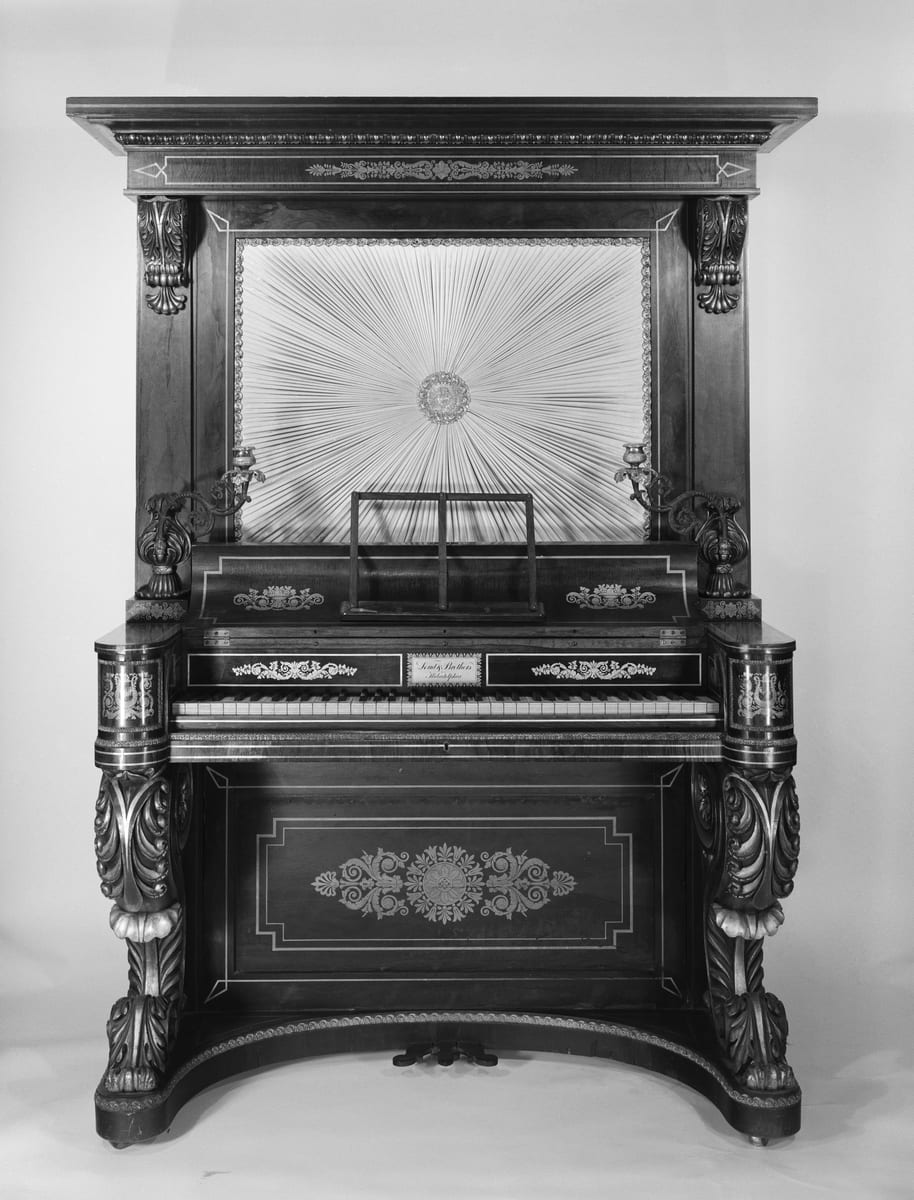
A honky-tonk is a cheap, noisy bar or dance hall, the rough-and-ready sort found across Texas and the American South, where the beer is cold, the floor is sticky and the band plays loud. The word also names the music that grew up in those rooms: honky-tonk is the hard-edged, electrified strain of country associated with Ernest Tubb and Hank Williams, while honky-tonk piano is the jangling, deliberately out-of-tune style heard in every Wild West saloon scene. British speakers mostly meet the word through the music, from fifties piano novelties to the Rolling Stones’ “Honky Tonk Women”, and use it, as noun or adjective, for anything loud, unpolished and cheerfully disreputable.
What’s the origin of the phrase ‘honky tonk’?
The word comes out of Texas, and its early history is written in Texas newsprint. The American etymologist Barry Popik traced the earliest known appearance to the Fort Worth Daily Gazette of January 1889, which reported that “a petition to the council is being circulated for signatures, asking that the Honky Tonk theater on Main street be reopened”. Nobody troubled to explain the term, which suggests Fort Worth readers already knew it. The spelling took years to settle: the Dallas Morning News of 1890 has a man who “wanted to go to the honk-a-tonk (variety show)”, and the Galveston Daily News of 1892 records a boy who “entered Andrews’ honkatonk on Fifteenth street and was ordered out on account of his age”.
These places were not simply bars. The honky-tonk of the 1890s was a low variety theatre attached to a saloon, offering drink, dancing, gambling and, often enough, prostitution. The word travelled with the cattle towns north into the Indian Territory, and the Daily Ardmoreite of Ardmore, in what is now Oklahoma, gave it its most quoted early outing in February 1894:
The honk-a-tonk last night was well attended by ball-heads, bachelors and leading citizens. Most of them are inclined to kick themselves this morning for being sold.
Where the word itself came from, nobody honestly knows. The Oxford English Dictionary gives its origin as unknown, and the guesses have not improved much on that. The likeliest is that it is simply imitative, “honk” and “tonk” together catching the racket of brass and battered upright piano spilling through a saloon door. A neater story derives “tonk” from the New York piano firm of William Tonk & Bros., whose instruments supposedly furnished such dives, but Popik found no printed reference to Tonk pianos before 1900, a decade after Texans were already complaining about honky-tonks. Nor can the racial slur “honky” be the source: Etymonline records that insult only from the mid twentieth century, so if the two words are connected at all, the slur came second.
The music took its name from the room. Etymonline finds honky-tonk attached to the music played in such saloons by 1921, and in country music it hardened into a genre label. The East Texas singer Al Dexter recorded “Honky Tonk Blues” at his first session in 1936, probably the first country record to put the term in a title, and Ernest Tubb’s “Walking the Floor Over You” (1941) set the pattern for the electrified barroom style that dominated the following two decades. Hank Williams, the style’s greatest exponent, recorded “Honky Tonkin’” in 1947 and took his own “Honky Tonk Blues” to number two on the American country chart in 1952.
Honky-tonk piano reached Britain as a novelty in its own right. When Winifred Atwell recorded “Black and White Rag” in the early 1950s she played an old upright her husband had bought from a junk shop in Battersea; billed as her “other piano”, it carried her honky-tonk style to a string of hits, including “Let’s Have Another Party” (1954), the first piano instrumental to top the UK singles chart. The Rolling Stones completed the word’s naturalisation in July 1969, when “Honky Tonk Women” spent five weeks at number one in Britain and four at the top of the American Billboard chart. For the crowds who filled the original honk-a-tonks, English already had a phrase: they were out to paint the town red.