

‘On the wagon’ – abstaining from alcohol. ‘Off the wagon’ – returned to drinking after an attempt to give it up.
‘On the wagon’ – abstaining from alcohol. ‘Off the wagon’ – returned to drinking after an attempt to give it up.
Suggested explanations of the origin of ‘on the wagon’ focus on actual wagons that were used to transport people; for example, condemned prisoners who had taken their last drink in this life and were transported to the gallows by wagon. Another story has it that Evangeline Booth, the US Salvation Army National Commander, toured the Bowery slums in a wagon picking up drunks and delivering them to sobriety. The phrase pre-dates Booth’s work in New York, so that can’t be the origin. It isn’t far from the truth though, but, as we’ll see below, no actual wagon rides were involved.
‘On the wagon’ was coined in the USA around the turn of the 20th century. The phrase began as ‘on the water-cart’, migrated to ‘on the water-wagon’ and finally to ‘on the wagon’.
The late 19th century saw the emergence of several temperance organisations, notably The Anti-Saloon League, founded in 1893 and The Woman’s Christian Temperance Union, founded in 1874. These followed on from the work of The Abstinence Society which had encouraged millions of men to ‘take the pledge’. The Pledge wasn’t just a vague intention to avoid drink; it was a specific and absolute promise never to drink again and was taken very seriously:
“I promise to abstain from all intoxicating drinks except used medicinally and by order of a medical man, and to discountenance the cause and practice of intemperance.
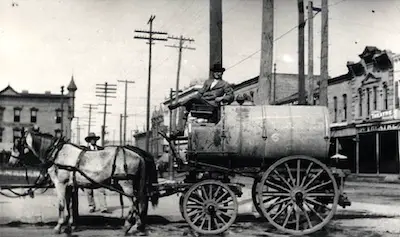
Water wagons were a commonplace sight in US cities at the time. They didn’t carry drinking water but were used to damp down dusty streets during dry weather. Those who had vowed to give up drink and were tempted to lapse said that they would drink from the water-cart rather than take strong drink.
The first reference to it that I’ve found in print is from Alice Caldwell Hegan’s comic novel Mrs. Wiggs of the Cabbage Patch, 1901:
I wanted to git him some whisky, but hoe shuck his head. “I’m on the water-cart.”
‘Water-wagon’ was soon used as an alternative and the distinction between the figurative phrase ‘on the wagon’ and real water-wagons was made clear in this piece from The Davenport Daily Leader, March 1904:
“Peter Solle took a bad fall from the water wagon this morning. The water wagon was not that imaginary, visionary affair that is sometimes applied to he who signs the pledge, but was the real thing, all there and big as life.”
See other phrases that were coined in the USA.
Trend of on the wagon in printed material over time
A B C D E F G H I J K L M N O P Q R S T UV W XYZ
American Animals Australian Bible Body Colour Conflict Death Devil Dogs Emotions Euphemism Family Fashion Food French Horses ‘Jack’ Luck Money Military Music Names Nature Nautical Numbers Politics Religion Shakespeare Stupidity Entertainment Weather Women Work
Have you spotted something that needs updated on this page? We review all feedback we receive to ensure that we provide the most accurate and up to date information on phrases.