

To hang a bell around a cat’s neck to provide a warning. Figuratively, the expression refers to any task that is difficult or impossible to achieve.
To hang a bell around a cat’s neck to provide a warning. Figuratively, the expression refers to any task that is difficult or impossible to achieve.
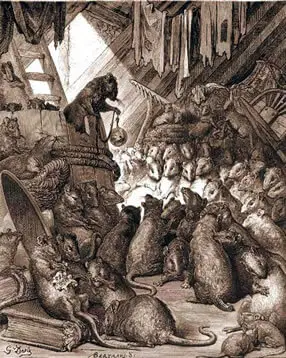
This expression ultimately derives from the fable, often attributed to Aesop, The Mice in Council. This story tells the tale of a group of mice who were terrorised by the house cat. One of them suggests that a bell be placed around the cat’s neck to warn of his arrival. Volunteers for the job are asked for but no mouse steps forward. The moral of the story (and with fables, there’s always a moral) is ‘don’t only consider the outcome when making plans; the plan itself must be achievable or it is useless’.
The attribution to Aesop is almost certainly incorrect. The tale doesn’t appear in any collection of Aesop’s Fables until the Middle Ages and is doubtless the work of a medieval mind.
The best known instance of the fable’s moral being put to work concerns the Scottish nobleman, Archibald Douglas, 5th Earl of Angus. In 1482, at a meeting of nobles who wanted to depose and hang James III’s favourites, Lord Gray is said to have remarked “Tis well said, but wha daur bell the cat?”, that is, ‘Who will take the necessary but highly risky action of openly defying the king?’. The story goes that Angus accepted and successfully accomplished the challenge. This story, like the Aesop attribution, is almost certainly a fanciful invention by later writers. While it is the case that the Earl of Angus was involved in an undoubtedly treasonable plot against James III, the ‘bell the cat’ story and Angus’s subsequent nickname didn’t arise until many years after his death. No earlier chronicler, not even Robert Lindsay of Pitscottie who was the official chronicler of the event, mentions the story. Nevertheless, the tag has stuck as an undeserved nickname for the fifth earl.
Trend of bell the cat in printed material over time
A B C D E F G H I J K L M N O P Q R S T UV W XYZ
American Animals Australian Bible Body Colour Conflict Death Devil Dogs Emotions Euphemism Family Fashion Food French Horses ‘Jack’ Luck Money Military Music Names Nature Nautical Numbers Politics Religion Shakespeare Stupidity Entertainment Weather Women Work
Have you spotted something that needs updated on this page? We review all feedback we receive to ensure that we provide the most accurate and up to date information on phrases.