
Regular readers of this mailing list will know that it has often featured ‘as x as y’ similes. These provide a rich source of colour in the language and most English speakers will be familiar with hundreds of them (see this list). The term’s usual format makes a link between some creature or object, say ‘a dodo’, and a well-known property of the same, that is, ‘dead’, and that applies to virtually all examples of this type of simile, e.g. ‘as black as coal/pitch/the ace of spades’, ‘as white as a sheet/ghost/snow’. However this pattern breaks down when it comes to happiness. Larks and dogs with two tails fit the bill as creatures known to be happy but the three best-known ‘happy’ similes are ‘as happy as a clam/a sandboy/Larry’. It is not now common knowledge as to why clams, sandboys or Larry should have been happy. For the phrases to have been adopted into the language in the first place such knowledge must have been widespread at some time. Let’s see if we can resurrect it.
As happy as a clam
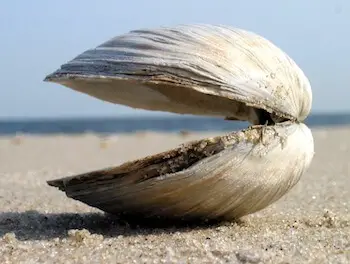
Why would clams be happy? It has been suggested that open clams give the appearance of smiling. The derivation is however more likely to come from the fuller version of the phrase, now rarely heard - ‘as happy as a clam at high water’. High tide is when clams are free from the attentions of predators; surely the happiest of times in the bivalve mollusc world.
The first record that I can find of the ‘high water’ version is from the Pennsylvania newspaper The Adams Sentinel, August 1844:
“Crispin was soon hammering and whistling away as happy as a clam at high water.”
The expression was well-enough known in the USA by the late 1840s for it to have been included in John Russell Bartlett’s Dictionary Of Americanisms - A Glossary of Words And Phrases Usually Regarded As Peculiar To The United States, 1848:
“As happy as a clam at high water,” is a very common expression in those parts of the coast of New England where clams are found.
As happy as a sandboy
‘Sandboy’ brings to mind images of children playing on the beach, making sand-castles and the like. That sounds happy enough, but it isn’t the source of the phrase. In fact, sandboys were tradesmen who delivered sand to public houses, theatres and homes in the 18th and 19th centuries. Children were used in that trade, but most sandboys were adults.
The earliest printed citation of the phrase that I can find is from Pierce Egan’s Real Life in London, 1821:
“…appeared to be as happy as a sand-boy, who had unexpectedly met with good luck in disposing of his hampers full of the above household commodity.”
Charles Dickens made an oblique reference to the variant form of the phrase, ‘as jolly as a sand-boy’, in his 1840 novel The Old Curiosity Shop, in which the inn The Jolly Sandboys features.
Carting sand was hard, dusty and not especially happiness-inducing work. The sandboys’ reputation for happiness seems to derive from their reputation of frequent intoxication.
As happy as Larry
Larry is certainly the best known character in the world of similes. The expression he instigated is most likely to be of Australian or New Zealand origin. The earliest printed reference currently known is from the New Zealand writer G. L. Meredith, dating from around 1875:
“We would be as happy as Larry if it were not for the rats”.
Almost all the other early citations are from Australia or New Zealand; for example, this from Tom Collins (the pen name of the popular Australian writer Joseph Furphy), in Barrier Truth, 1903:
“Now that the adventure was drawing to an end, I found a peace of mind that all the old fogies on the river couldn’t disturb. I was as happy as Larry.”

But who was Larry? There are two commonly espoused contenders. One is the Australian boxer Larry Foley (1847 - 1917). Foley was a successful pugilist who never lost a fight. He retired at 32 and collected a purse of £1,000 for his final fight. So, we can expect that he was known to be happy with his lot in the 1870s - just when the phrase is first cited.
The alternative explanation is that it relates to the Cornish and later Australian/New Zealand slang term ‘larrikin’, meaning a rough type or hooligan, that is, one predisposed to larking about. ‘Larrikin’ would have been a term that Meredith would have known - the earliest printed reference is also from New Zealand and around the time of the first citation, in H. W. Harper’s Letters from New Zealand, 1868:
“We are beset with larrikins, who lurk about in the darkness and deliver every sort of attack on the walls and roof with stones and sticks.”
See other ‘as x as y similes’.