

Other phrases about:
To have a dog in the manger attitude is to be spiteful and mean-spirited.
To have a dog in the manger attitude is to be spiteful and mean-spirited.
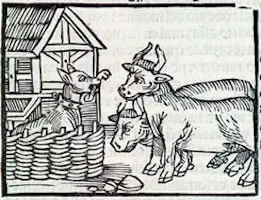
The infamous ‘dog in a manger’, who occupied the manger not because he wanted to eat the hay there but to prevent the other animals from doing so, is generally said to have been the invention of the Greek storyteller Aesop (circa 600 BC).
Many of the fables that have been credited to Aesop do in fact date from well before the 5th century BC and modern scholarship doesn’t give much credence to the idea that Aesop’s Fables, as we now know them, were written by him at all. Accounts of Aesop’s life are vague and date from long after his death and some scholars doubt that there ever was a real Aesop. If he existed at all, it was as an editor of earlier Greek and Sumerian stories rather than as the writer of them.
Nothing written by Aesop now exists in any form. Nevertheless, you can go into any bookshop and buy a copy of ‘Aesop’s Fables‘ and, for this book more than others, that is largely thanks to the invention of the movable type printing press. Following the production of the Gutenberg Bible in the 1450s, European printers began to look around for other suitable works to print. What better way to educate the common herd than to provide them with the uplifting moral tales of Aesop? The German printer Heinrich Steinhowel set to the task and printed the first German version in 1480. The first English version followed soon after when Caxton adapted the German version into English in 1484.
It seems that Steinhowel had decided that Aesop’s fables weren’t quite uplifting enough and he added the ‘Dog in the Manger’ in his 1480 version. There’s no mention of the story in the Greek descriptions of the fables, some of which date from the 4th century BC. While not being included by Aesop, the story itself is ancient, having been cited in several early Greek texts and in English in John Gower’s Confessio Amantis, circa 1390:
Though it be not the hound’s habit
To eat chaff, yet will he warn off
An ox that commeth to the barn
Thereof to take up any food.
The first specific reference to ‘a dog in a manger’ is quite old, being first cited in William Bullein’s A dialogue against the feuer pestilence, 1564:
“Like vnto cruell Dogges liyng in a Maunger, neither eatyng the Haye theim selues ne sufferyng the Horse to feed thereof hymself.”
‘Dog in the manger’ is still used allusively to refer to any churlish behaviour of the ‘spoilsport’ sort. If Google searches are anything to go by, you are just as likely to find it written as ‘Dog in the manager’, a surreal version that escaped even the inventive Steinhowel.
Trend of dog in the manger in printed material over time
A B C D E F G H I J K L M N O P Q R S T UV W XYZ
American Animals Australian Bible Body Colour Conflict Death Devil Dogs Emotions Euphemism Family Fashion Food French Horses ‘Jack’ Luck Money Military Music Names Nature Nautical Numbers Politics Religion Shakespeare Stupidity Entertainment Weather Women Work
Have you spotted something that needs updated on this page? We review all feedback we receive to ensure that we provide the most accurate and up to date information on phrases.