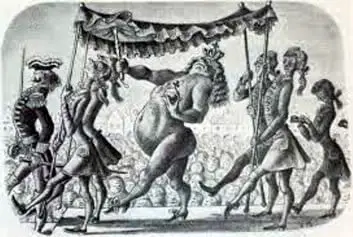
‘The emperor has no clothes’ is said of an obvious truth that nobody will admit. ‘The emperor’s new clothes’ is the worthless thing everyone is praising. Both come from a Hans Christian Andersen fairy tale printed in 1837, in his collection Eventyr, fortalte for Børn, or Fairy Tales Told for Children.
What’s the origin of the phrase ‘The emperor’s new clothes’?
The expression ‘the emperor’s new clothes’ or variants like ‘the emperor has no clothes’ are difficult to explain briefly and are most easily understood by looking at its source, that is, Hans Christian Andersen’s fable The Emperor’s New Clothes, 1837.
Andersen’s tale involves a vain king who was preoccupied with his appearance and his wardrobe. A pair of swindlers took advantage of this by pretending to be able to weave the finest cloth, which couldn’t be seen by people who were either unfit for office or were particularly stupid. The king decided to have a suit of clothes made from the fabric in order to test which of his courtiers was unfit for office. As he didn’t want to appear stupid or unfit for rule himself, he pretended to be able to see the new clothes, as did all of his courtiers. He paraded the ‘new clothes’ through the streets and the onlookers, also not wishing to appear stupid, all admired them. A small child, who didn’t understand the apparent necessity for pretence, piped up ‘But he has nothing on!’. The bubble of pretence burst and soon all the onlookers were repeating what the child had said, whilst the king continued the procession, attempting to maintain his dignity by pretending that nothing had happened.
So, the meaning of the expression is clear from the story. It is used in contexts where people are widely acclaimed and admired but where others question whether what they have created is of any value. Modern-day examples might be the highly priced work of conceptual artists or the more avant-garde products of fashion designers.
The phrase bears some similarity to another modern-day expression - the elephant in the room. An essential factor with both phrases is the willingness of people to enter into an unspoken contract to wilfully disbelieve what they know to be true.
The plot turns on a condition attached to the cloth. The two swindlers give out that clothes made from it have the property of “remaining invisible to everyone who was unfit for the office he held, or who was extraordinarily simple in character”, in the translation printed as Andersen’s Fairy Tales at Project Gutenberg. That condition is what silences the court. To say you cannot see the suit is to confess that you should not be holding your job, and the swindle holds because nobody is willing to make that confession.
The child’s line in that translation is “But the Emperor has nothing at all on!”. Andersen’s Danish, in the text at Danish Wikisource, is “Men han har jo ikke noget paa,” sagde et lille Barn. The modern variant ‘the emperor has no clothes’ repeats the child’s words rather than the title of the tale, which is why the shorter form is the one people reach for when they want to state the plain fact rather than name the thing being admired.
Andersen does not end the story with the pretence collapsing. The emperor hears the crowd, knows they are right, and keeps walking: “The Emperor was vexed, for he knew that the people were right; but he thought the procession must go on now!” Being seen through does not stop him, and that is part of what the phrase carries when it is used of an institution rather than a person.
The Cambridge Dictionary defines the phrase as a situation in which most people praise or seem to believe something that is false or has no value, because they are afraid to go against the general opinion, and glosses the story as one in which nobody except a young boy is willing to say publicly that the emperor is naked.
The tale in Danish is ‘Keiserens nye Klæder’. Project Runeberg’s copy of Andersen’s collection Eventyr, fortalte for Børn, digitised from the Royal Danish Library’s scan, is dated 1837 and lists Keiserens nye Klæder among its tales.